


 admin
admin
When the Commonwealth Bank of Australia (CBA) rushed to automate its customer service, the goal was to deploy a cutting-edge AI voice bot, slash overhead, and prove the bank was leading the digital race. Instead, the implementation backfired spectacularly, triggering a massive wave of frustrated callers that ultimately forced executives to apologize and rehire the very staff they had just laid off. This high-profile retreat exposes a critical blind spot in modern business strategy: the dangerous temptation to treat AI as a plug-and-play savior. In the frantic race to avoid being left behind, businesses are blindly purchasing tools without asking the most fundamental question of all; does this technology actually fit our business promise, or is it actively eroding our competitive edge?
Over the past year, I’ve noticed that almost every business conversation eventually finds its way back to AI. Business owners are asking whether they should be using it to reduce costs, improve productivity, strengthen customer service or simply remain competitive in an environment that seems to be changing by the day. In the scramble to stay ahead of the digital curve, many businesses are falling into the “FOMO trap,” rushing to deploy AI tools without first questioning if the technology aligns with their core identity.
Every week seems to bring another AI tool, another success story and another prediction about how AI will transform entire industries. It’s easy to feel that the conversation has become a race, and that the businesses moving fastest will inevitably come out ahead. That pressure alone has led many businesses to start looking for AI before they’ve taken the time to understand what problem they’re actually trying to solve, and that is where the conversation should pause for a moment.
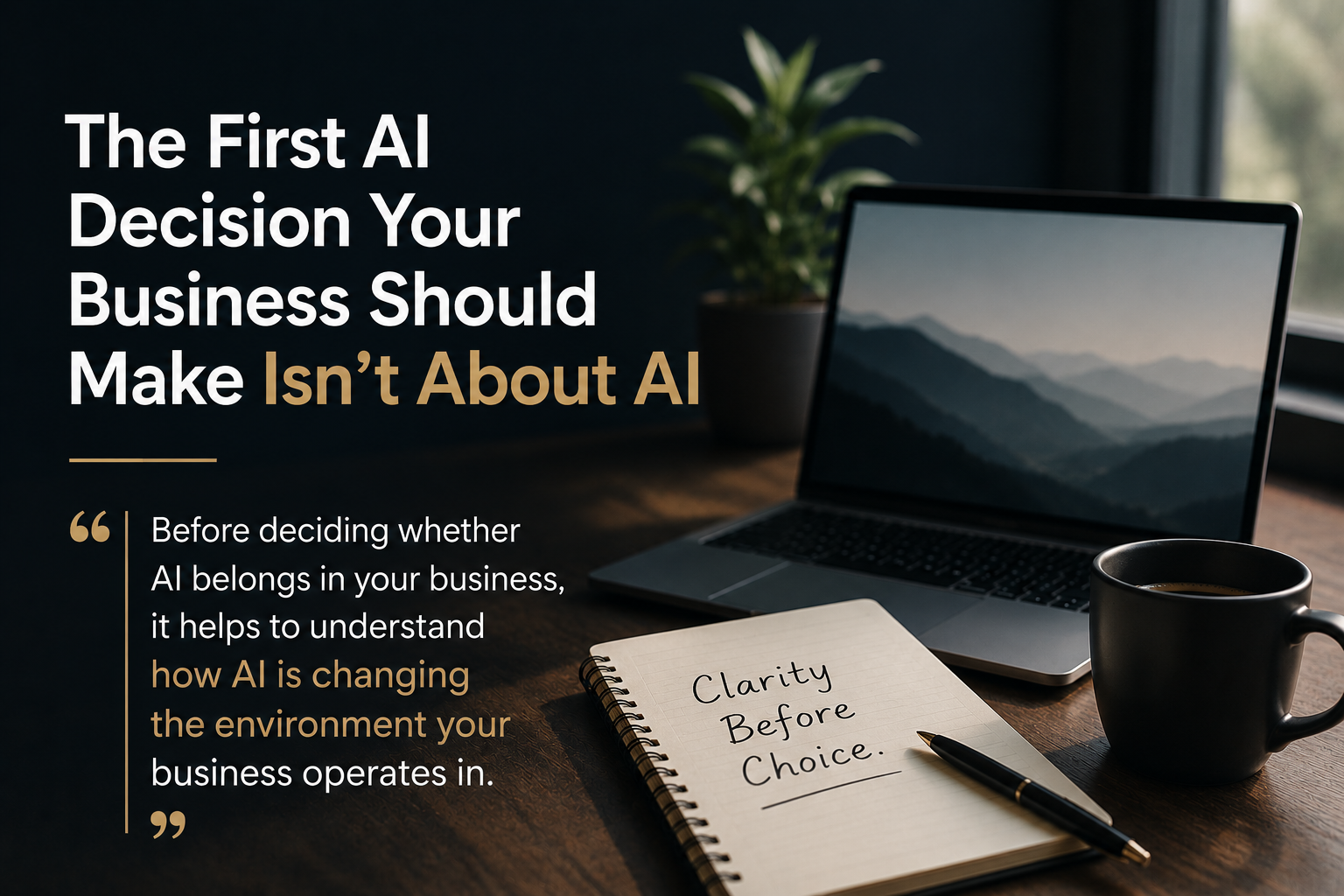
Before deciding whether AI belongs in your business, it helps to understand how AI is changing the environment your business operates in.
1. Understand how AI is changing your industry
The first place to look is not inside your own business but around it.
Every industry is experiencing the impact of AI differently. For some, the change is happening rapidly. For others, it is more subtle, showing up in new competitors entering the market with different cost structures, customers beginning to expect faster responses or suppliers quietly integrating AI into the platforms businesses use every day, gradually changing the way work is done without their customers consciously deciding to adopt AI or reviewing alignment with the rest of their operations.
The retail sector offers a good example. Customers have become used to personalised product recommendations, intelligent search and near-instant responses because many of the platforms they interact with every day now use AI behind the scenes. A small retailer may never have invested in AI directly, yet customer expectations have already changed because of the broader market. Recognizing that shift is far more important than rushing to buy the latest AI tool, because until you understand how your industry is evolving, it’s difficult to know whether your business needs to respond at all.
2. Understand how AI is already affecting your business
Once you have a clearer picture of what is happening around your industry, the next step is to consider what those changes mean for your own business.
This is often the point where businesses realize AI is already much closer than they thought. They may not have made a deliberate decision to adopt it, but it has quietly found its way into accounting software, customer relationship platforms, supplier systems and even the way employees complete everyday tasks.
At the same time, it is worth asking whether AI is changing what makes your business competitive or put another way, your business identity. If your customers have always valued speed, has AI changed what they now consider “fast”? If your business differentiates itself through technical expertise, are customers beginning to expect quicker answers because AI has made information more accessible? If your brand has been built on personalized service, will AI strengthen or dilute that promise? AI doesn’t automatically change what makes your business valuable. What it can change is how customers perceive that value, and that is often where businesses need to pay attention.
These are important questions because they help you distinguish between adopting AI simply because everyone else is talking about it and adopting AI because your business genuinely needs to respond to a changing environment.
3. Decide whether your business actually needs AI
Only after understanding how AI is changing your industry and how those changes are affecting your business does it make sense to decide whether AI has a role to play in your own strategy.
For some businesses, that answer will be yes because AI genuinely helps them improve efficiency, strengthen customer experience or solve a problem that already exists. For others, the benefits may be less compelling today, and there is nothing wrong with reaching that conclusion. The important thing is that the decision is deliberate, because businesses should not feel pressured into adopting AI because it has become a popular topic, nor should they dismiss it simply because they remain skeptical. Both decisions deserve careful thought.
The conversation around AI is unlikely to disappear any time soon, and like every significant shift before it, it brings both opportunities and challenges. The businesses that navigate it successfully won’t necessarily be the first to adopt every new tool that enters the market. More often, they’ll be the businesses that recognize how their environment is changing, understand what those changes mean for their customers and competitive position, and make thoughtful decisions while they still have the freedom to choose.
Businesses don’t become less resilient because of changes, but because they fail to recognize the change early enough, understand what it means for their business and respond appropriately before they’re forced to; key word being “appropriately” because it isn’t about making the same decision as everyone else, but making the right decision for your business. Therefore, responding appropriately may not always mean adopting AI. It could mean adopting it quickly, cautiously or even deciding that your business is better served by strengthening something else entirely
In our next article, we’ll build on this discussion by exploring what businesses should consider once they have identified a genuine need for AI, and how they can make the transformation safely without introducing new vulnerabilities along the way
