


 admin
admin
Every business runs into problems at some point. Customers complain, projects are delayed, cash becomes tight, employees make mistakes and sales fluctuate, but most business owners accept these as part of running a business because solving problems is simply part of the journey. The real concern is not that problems happen at all, but that the same problem keeps returning even after it has supposedly been fixed.
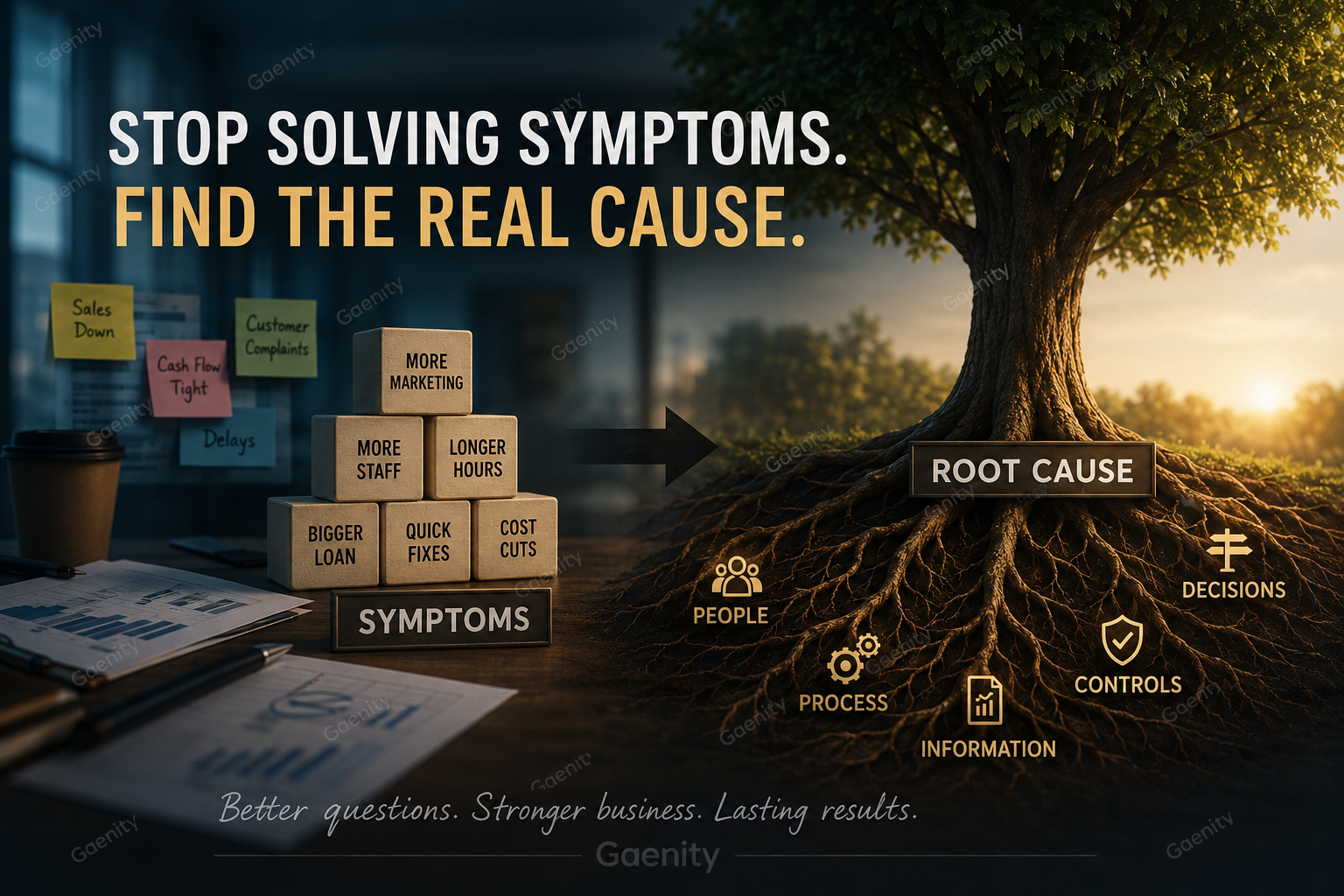
Consider these familiar situations. Sales begin to slow, so more money is spent on marketing; Cash flow comes under pressure, so another loan is arranged; Customers complain about delays, so another employee is hired; Each of these actions may provide temporary relief, but when the same issue resurfaces a few months later, it usually suggests that the business has addressed what was visible while the underlying cause has been left unresolved.
That distinction matters because businesses rarely become more resilient by becoming better at responding to recurring problems. They become more resilient by understanding why those problems became possible in the first place and strengthening the business so they are less likely to happen again. Risk professionals often refer to this way of thinking as root cause analysis, but the principle itself is straightforward: solve the problem that created the symptom, not just the symptom itself.
This is not unique to SMEs. Even in large organisations, one of the most common reasons recurring problems continue, as an example, is that investigations stop at “human error.” In practice, that answer is rarely enough because, while people make mistakes, businesses create the conditions that allow those mistakes either to remain isolated or to become recurring operational problems. Better training, clearer processes, better information, stronger controls or different business decisions often do far more to prevent the next mistake than simply reminding people to be more careful.
The same principle applies well beyond employee mistakes. Every recurring problem usually has underlying conditions that allowed it to develop, and unless those conditions change, there is every reason to expect that the problem will return.
This is why one small change in the way businesses approach problems can produce much better outcomes. Rather than asking only, “Why did this happen?”, it is often more valuable to ask, “What made this possible?” The first question usually leads to the last event before the problem occurred, while the second encourages the business to look beyond the obvious and examine the environment that allowed the problem to develop.
Looking beyond the obvious does not require complicated methodologies or technical frameworks. In practice, asking a handful of well-directed questions is often enough to separate symptoms from causes, and over time those questions become a far more valuable habit than jumping straight to solutions. These questions do not produce an immediate answer, but are designed to stop businesses from jumping to one. Before deciding on the solution, use each question to test whether the real problem lies somewhere deeper than the obvious symptom.
1. People – Was this really a people problem?
People are often the most visible part of a business problem because they are the ones carrying out the work, but that does not necessarily mean they are the reason the problem exists. Were employees close to the issue properly trained? Were expectations clear and consistent? Did they have the right tools, support and enough time to complete the task properly? If the answer to any of those questions is no, then the issue may not be the individual at all. It may be the environment in which they were expected to succeed.
2. Process – Was there a process that people could consistently follow?
Many SMEs are vulnerable to key person dependency and operate successfully because one or two experienced people simply know how things are done. While that approach often works in the early stages of a business, it becomes increasingly difficult to maintain as the business grows because knowledge that exists only in people’s head cannot easily be transferred, measured or improved. If different employees complete the same task in different ways, or if success depends heavily on one individual, what appears to be a people problem may actually be a process problem.
3. Information – Did people have the information they needed?
Even good people following good processes can make poor decisions when they are working with incomplete or outdated information. Customer requirements may not have been communicated clearly, inventory records may no longer be accurate, pricing may have changed without everyone knowing, or reports may have arrived too late to support timely decisions. Before concluding that someone exercised poor judgement, it is worth asking whether they had everything they needed to make the right decision in the first place. Check your business data, what’s the quality and availability of the data needed to perform these functions?
4. Controls – What should have detected the problem before it became a customer problem?
No business can eliminate every mistake, and that should never be the expectation. Strong businesses, however, usually have ways of identifying problems before customers experience them or before the financial impact becomes significant. A review before an invoice is issued, a quality check before a product leaves the warehouse, an approval before a payment is made or a reconciliation before month-end may seem like small activities, but they often prevent relatively minor mistakes from becoming much larger operational problems. When issues are consistently discovered only after customers complain or money has already been lost, it is worth considering whether an important control is missing.
5. Decisions – Did a business decision create the conditions for this problem?
Every business makes choices about where to invest, what can wait, how much risk it is willing to accept and where limited resources should be directed. Sometimes, what appears to be a people, process, information or control issue is actually the result of a business choice that made sense at the time but quietly increased the business’s vulnerability.
Choosing to rely on one experienced employee because hiring another person seemed too expensive, delaying investment in systems to preserve cash, or skipping documentation because the team was still small, are all examples of decisions that can quietly create vulnerabilities. They are not necessarily wrong decisions, but every decision represents a trade-off, and every trade-off carries consequences that may not become visible until much later.
When a recurring problem can be traced back to one of those choices, solving the immediate issue is only part of the answer. It is equally important to revisit the decision itself and ask whether the assumptions that made sense then still reflect the reality of the business today. As businesses grow and circumstances change, decisions that once supported growth can eventually become the very things that limit resilience. It then becomes necessary to formalize a process for not only arriving at those decisions, but also for periodically reviewing them to ensure that they remain reasonable with assumptions that continue to be valid.
The next time a business problem appears, understanding why the problem became possible in the first place is often where the real opportunity for improvement begins. Businesses that consistently ask better questions rarely just solve today’s problem. Instead, they gradually improve the way decisions are made, work is performed and risks are managed, making tomorrow’s problem less likely to happen at all.
