


 admin
adminEvery business wants to operate more efficiently. As organisations grow, manual activities become more difficult to manage, customer expectations continue to rise, and operations become increasingly complex. Technology has made it possible to automate almost every business process, making software one of the first places organisations look when operational challenges emerge.
That shift has changed the way businesses operate and the way many operational decisions are made. Once a process becomes inefficient, the search for a software platform often begins almost immediately and the technology itself becomes the focus, even though the decision should extend beyond simply purchasing software. Other considerations, such as how much operational control should be retained by the business, rarely receive the same attention as functionality, yet they often have as much, or sometimes greater, influence on the long-term success of the investment.
WHEN DEPENDENCY BECOMES PART OF THE PROCESS
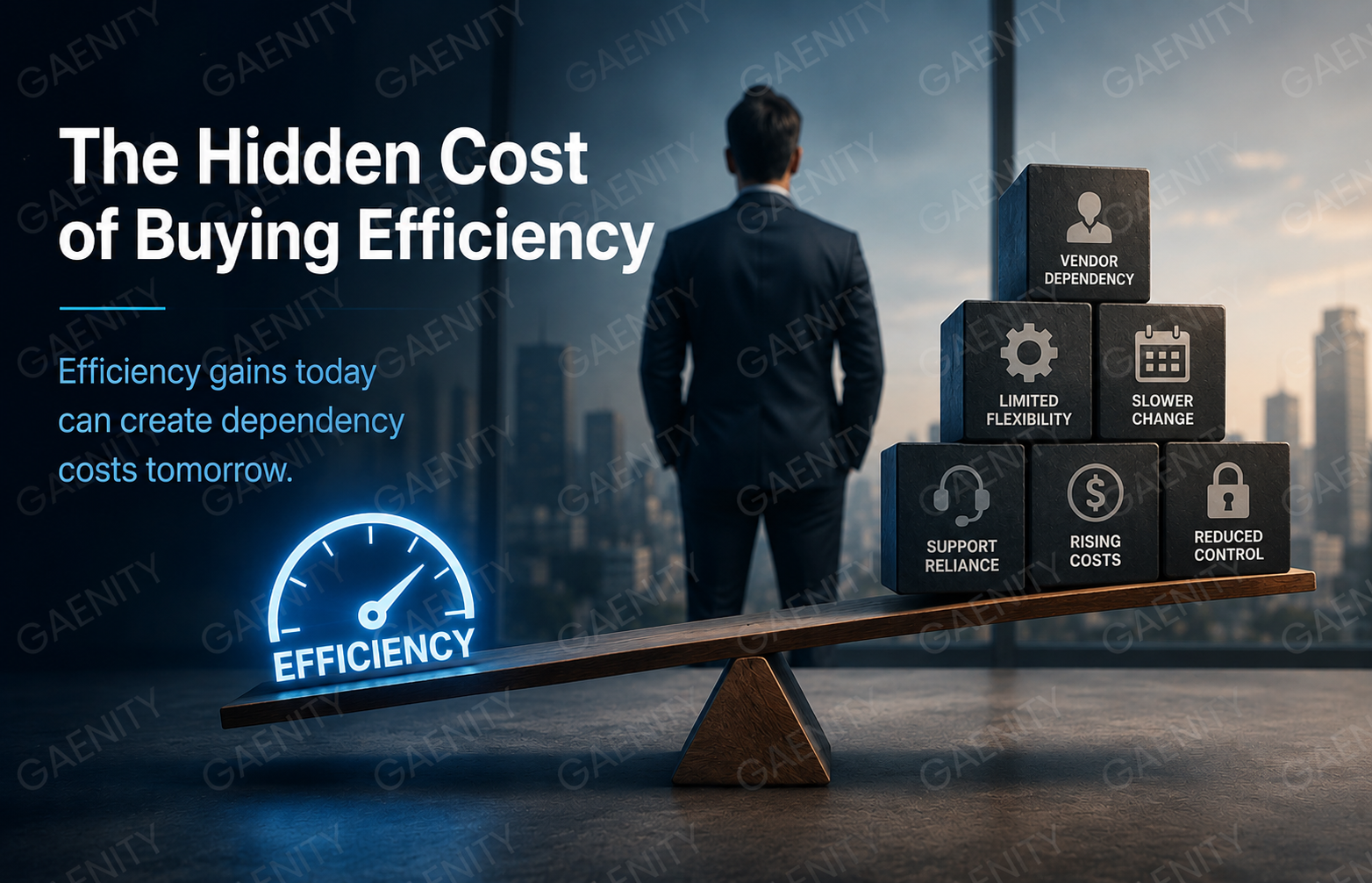
Vendor dependency rarely becomes apparent until a platform becomes part of the organisation’s day-to-day operations. At that point, important aspects of that capability begin to depend on parties outside the business.
As that dependency grows, the organisation is no longer the only party involved in how the process evolves, and changes that would once have been made internally may depend on external teams, introducing another layer of coordination into what was originally intended to be a simpler operation. This shift, which is not always obvious at the outset, has shaped the outcome of many large technology programmes. Projects that began with clear objectives, realistic budgets and achievable implementation timelines have continued for years or failed to deliver projected benefits as vendor support challenges, product limitations and changing business requirements accumulated. While the original objective of improving efficiency remained unchanged, organisations eventually found themselves managing both the business process and the dependency created by the platform supporting it.
NOT EVERY PROCESS DESERVES THE SAME SOLUTION
Not every business process carries the same strategic importance, and they should not all be approached in the same way.
Some processes support the business without defining it. Payroll, accounting, email, human resources and office productivity are good examples. These activities are essential, but they rarely determine whether one organisation performs better than its competitors or define what differentiates it in the market. Mature software solutions already exist, are continuously improved by specialist providers and are often the most practical choice.
Other processes, on the other hand, are central to how the organisation creates value and therefore require a more careful assessment of how much ownership the business wants to retain. These may support customer delivery, enable faster decisions, improve service quality or reflect years of operational experience that competitors cannot easily replicate. These capabilities often evolve gradually until they become embedded in the business itself. Improving them remains important, but the decision extends beyond selecting the best software available in the market.
Purchasing a platform does more than introduce new technology. It also introduces new operational relationships. Future enhancements may depend on the vendor’s product roadmap, operational issues may require external support before they can be resolved, business requirements may need to fit within the platform’s design rather than the platform adapting to the business, and changes in pricing, licensing or support models can also influence how the capability evolves over time. As a result, process resilience no longer depends solely on system stability, but also on vendor reliability and support performance.
OWNERSHIP IS ALSO A STRATEGIC DECISION
Technology decisions eventually become operational decisions, and operational decisions continue shaping the business for a long time.
These decisions shape how that capability will evolve as the business grows, customer expectations change and new operational challenges emerge. While some organisations will conclude that an established platform provides the right balance of efficiency, capability and ongoing support, others, particularly where the process is closely connected to how the business creates value, may conclude that retaining greater ownership provides the flexibility to adapt more quickly, make changes without external constraints and develop the capability alongside the business itself. For the latter, developing an in-house solution that retains greater ownership of critical business operations may prove to be the better option.
Neither approach is universally better because each creates a different operating model with a different set of outcomes. The more important consideration is whether those outcome trade-offs reflect the importance of the capability and the way the organisation expects it to evolve over time.
LOOKING BEYOND EFFICIENCY
Technology will continue to play an increasingly important role in business transformation. Automation, artificial intelligence and digital platforms are reshaping how organisations operate, and many of those investments will deliver substantial benefits.
Efficiency, however, is only one outcome of the decision, and the operating model created by that investment will influence the business long after implementation has been completed. Whichever operating model a business chooses, the trade-offs may be entirely appropriate. Understanding those trade-offs, however, allows organisations to evaluate technology investments more completely, particularly where the capability supports activities that are central to how the business operates
