


 admin
admin
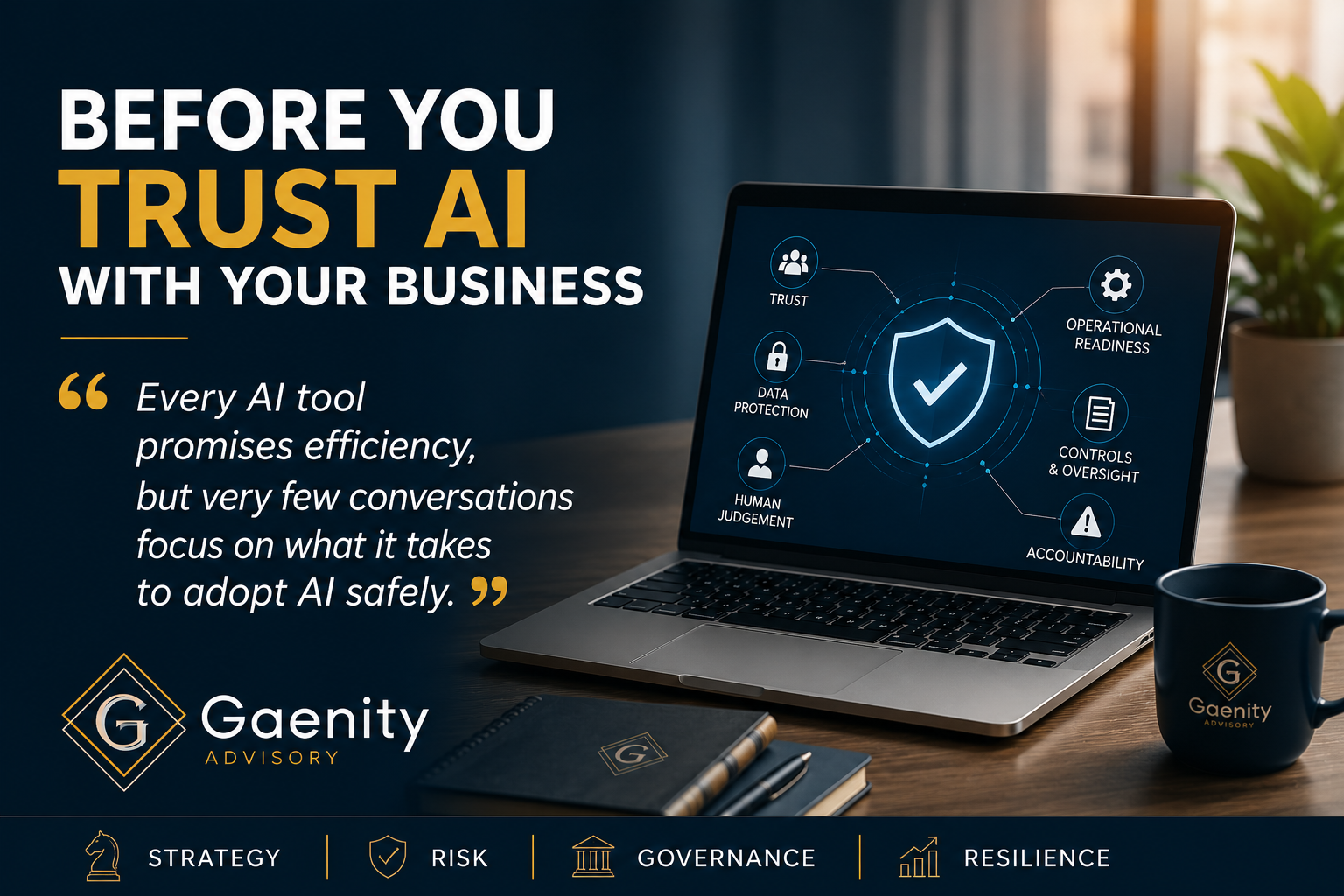
Last week, we explored a question that many businesses overlook in the rush to adopt AI: does AI actually belong in the business? Before investing in any AI tool, it made sense to understand whether it solved a genuine business problem, whether it strengthened the business’s competitive position and whether it aligned with the way the business creates value. Once those questions have been answered and the decision has been made to move forward, the conversation changes to how to integrate the new solution into your business. Every AI tool promises efficiency, but very few conversations focus on what it takes to adopt AI safely. Yet, that is often where the success or failure of an AI implementation is decided.
The reality is that most vendors do an excellent job of demonstrating what their products can do, but the challenge for a business owner is looking beyond the exciting things it can do and thinking about what happens after the tool becomes part of everyday operations. That means considering how it will fit into the business, what new risks it may introduce and what controls should remain in place to ensure the business continues to operate safely. Before introducing AI into your business, there are five areas worth exploring.
- Can the AI be trusted?
When businesses evaluate AI, they naturally focus on its capabilities. While this is important, capability alone does not tell you whether the tool is reliable enough for the decisions your business intends to make with it. Every AI system will occasionally produce inaccurate or unexpected outputs, the question is whether the people behind the tool understand those limitations and have a disciplined way of spotting potential inaccuracies and managing them.
Spend some time understanding how the AI is tested, how accuracy is measured and how performance is monitored over time. Your due diligence should include confirming how errors are identified and the transparency in communication to customers, how they are corrected and how often the model is reviewed. You are not looking for a perfect AI tool because one does not exist. Instead, you are looking for evidence that the vendor understands where the tool performs well, where it may struggle and how they continue to improve it. Those conversations will often tell you far more about the quality of the product than the demonstration itself.
- What support sits behind the AI?
Like every other technology tool, adopting an AI tool is not simply a software purchase, it is the beginning of an ongoing relationship with the company or person that built it. As your business grows, regulations evolve and the technology itself changes, you need confidence that the vendor will continue to support the product to meet your business needs, rather than simply sell it.
Take the opportunity to understand how the AI is maintained after implementation and how frequently is it updated. How are significant changes communicated to customers? Is there a clear process for reporting issues and receiving support? If regulations change or a problem is identified, how quickly can the vendor respond? A critical part of your business will be relying on these tools, and these questions are about understanding the level of governance that sits behind the product you are bringing into your business. A tool with insufficient support could become a bad idea for integrating into your business
- Is your business information protected?
For many businesses, information is one of their most valuable assets. Financial information, customer records, pricing, supplier contracts and business plans all tell part of the story of how a business operates. Before sharing that information with an AI tool, it is worth understanding how it will be protected.
Ask where your information will be stored, whether it will be used to train future versions of the AI and who retains ownership of the data once it has been uploaded. Depending on your industry, you may also have privacy, contractual or regulatory obligations that influence how information can be shared. If the answers are not immediately clear, ask for them in writing. Good vendors should be able to explain how they protect customer information in language that business owners can understand.
- How will AI change the way your business operates?
This is the conversation that many businesses may underestimate. Even the best AI tool becomes a source of risk if the people using it don’t understand what it can and cannot do, and how it changes business processes. Before introducing AI into everyday work, take time to explain where it should be used, where human judgement is still required and what employees should do when something doesn’t look right. Including proper training on the use, functionality and output of the tool as part of your change management plan is often as important as the technology itself.
Introducing AI may change how reports are prepared, how customer enquiries are handled, how approvals are given or how financial information is reviewed. Walk through the processes that will be affected, identify where controls may need to change and consider whether additional training, documentation or oversight will be needed. The objective is to integrate AI in a way that strengthens the way your business already operates.
- Can your business remain in control?
One of the biggest misconceptions about AI is that adopting it means handing over decisions to technology. In practice, the businesses that benefit most from AI are usually the ones that remain firmly in control of the decisions that matter.
Before AI becomes part of your day-to-day operations, decide which activities should always require human judgement, who remains accountable for important decisions and what should happen if the AI produces an unexpected output or becomes unavailable altogether – consider your business model, value proposition, and competitive advantage. AI should support good business judgement and positioning, not replace or weaken it. Keeping people accountable, particularly for decisions that affect customers, financial reporting or regulatory obligations, is one of the simplest ways to reduce unnecessary risk while still benefiting from the efficiencies AI can provide.
The businesses that will get the greatest value from AI are the ones that take a little more time to understand how it will affect their business before they switch it on. Whether you are specifically purchasing an AI tool to perform a function, or using a vendor platform that has AI capabilities, introducing AI safely is often the difference between technology that genuinely strengthens a business and technology that creates problems the business never expected.
In our next article, we’ll explore what happens after implementation and how businesses can continue to monitor AI over time to ensure it remains accurate, reliable and aligned with the way the business continues to evolve.
