


 admin
admin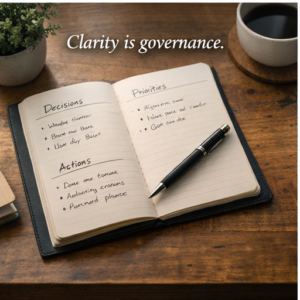
“Governance” often sounds heavier than it needs to be, which is why many small business owners instinctively distance themselves from it. It tends to bring to mind large boards, formal structures, and extensive documentation, none of which feel relevant in a growing business.
In practice, governance is much simpler and far more practical. It is about how decisions are made, how responsibilities are understood, and how people remain aligned as the business evolves.
When governance is light but clear, work tends to feel easier because there is less ambiguity. When it is missing, even simple things begin to feel harder than they should.
What governance looks like in a small business
• Clear roles: who decides pricing, who approves spending, who owns customer issues
• Simple rules: what gets documented, how exceptions are handled, what standards are expected
• A regular rhythm: weekly priorities, monthly reviews, and periodic resets
It does not require layers or bureaucracy, just clarity that people can rely on.
Signs your governance needs attention
• Everyone defaults to the owner for even small decisions
• Policies exist informally across emails or conversations rather than in one place
• Priorities shift frequently, leading to repeated work
• People are working hard, but not always in alignment
A practical governance reset
Rather than introducing complexity, the goal is to make what already exists more consistent and visible.
Step 1: Decide once
Identify decisions that are made repeatedly and define a simple rule for each. This reduces the need to revisit the same issue multiple times.
Step 2: Put decisions where people work
Create a short “how we work” document that captures key processes across areas like sales, service, finance, and people. Keep it simple and accessible.
Step 3: Establish a steady rhythm
• Weekly: review priorities and immediate blockers
• Monthly: review performance, cash, and key risks
• Quarterly: decide what to stop, start, and scale
The payoff
• Faster decisions with less friction
• Reduced reliance on one individual
• Fewer repeated mistakes
• A business that can function without constant intervention
Many founders worry that governance will limit flexibility, but in reality, it creates the conditions for better focus and more effective execution.
The Gaenity view
At Gaenity, governance is not about control; it is about clarity. When decisions are clear and consistent, the business becomes easier to run and better positioned to grow.
Call to action: If helpful, I can share a simple five-page “how we work” template that you can adapt to your business.
